
1. What you get at review
DoseRelay is a passive self-titration log: the patient logs on Telegram or WhatsApp, the week compiles, and the clinician sees a structured PDF at a scheduled follow-up — not a live inbox to watch.
- No dose recommendations — no suggested doses or automatic schedule changes.
- Prescriber-in-the-loop — interpretation and dose decisions stay with the qualified UK prescriber.
- Review prep, not live monitoring — the patient brings the PDF to the appointment.
- Not a medical device — self-report logging for visit preparation; no automated diagnosis.
2. Data isolated by design
DoseRelay is not a clinic EMR. We do not use NHS numbers or legal names as the product primary key.
- Tokenised records: patients appear as opaque tokens (e.g.
Patient-AX92) in reports and storage. - Local mapping only: linking a token to a real identity stays inside the clinic’s own EMR / process.
- Isolated clinical data: the working set is self-log content under a token — not a full demographic dossier.
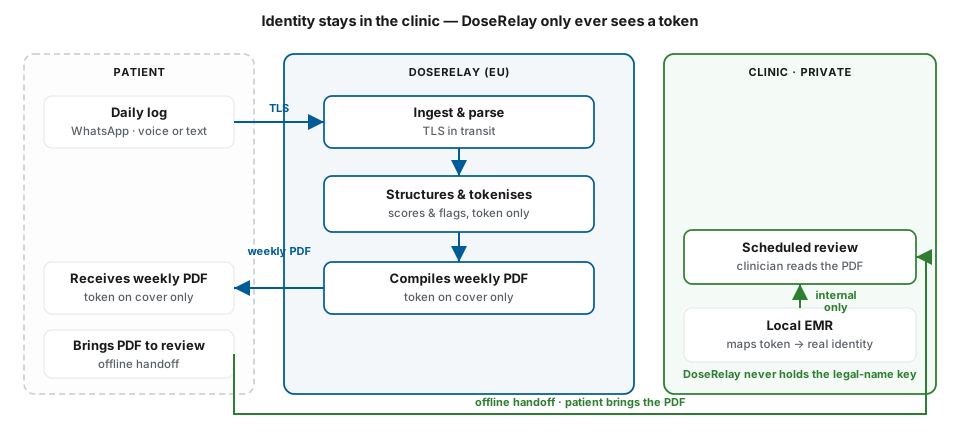
Real identity stays in clinic systems. DoseRelay stores tokenised logs and returns a PDF to the patient — the handoff into the appointment is offline.
3. Bridging patient ease and clinical clarity
Patient-side: as easy as a WhatsApp voice note — text or voice in seconds.
Clinician-side: a structured, scannable summary ready for review — not a stream of unstructured messages to decode mid-appointment.
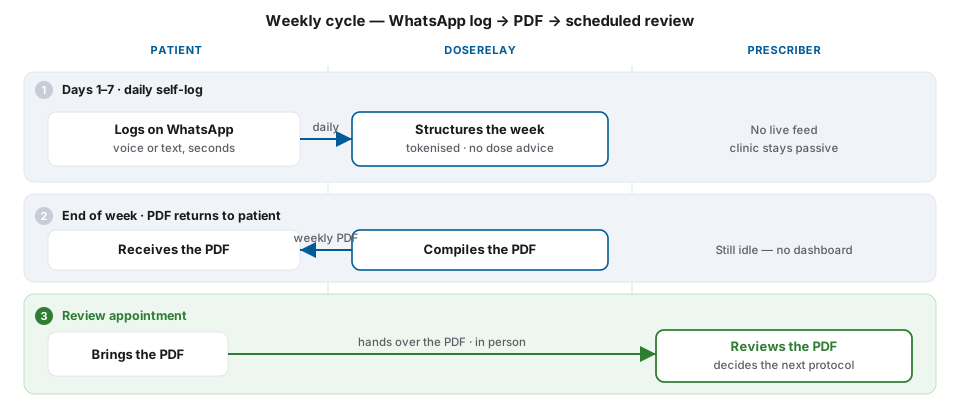
Days 1–7 low-effort WhatsApp input → PDF to patient → brought to review. Prescriber column stays quiet until then.
4. Data protection posture
DoseRelay is an early private pilot product. We document what we actually do — and what we do not claim yet — so clinics and technical reviewers are not guessing from HTTPS alone.
- EU hosting: application stack on Hetzner VPS in the EU (Germany). Marketing site is static content on the same operator infrastructure.
- Encryption in transit: TLS for public HTTPS endpoints and service connections we control.
- At rest (pilot honesty): Postgres + app data live on that EU VPS with access control (SSH keys, container isolation, secrets kept out of git). We do not currently claim full-disk encryption certification, field-level encryption, ISO 27001, Cyber Essentials, or an independent pen-test badge.
- No public model training: patient self-logs are not used to train public foundation models. We do not sell log data.
- UK GDPR roles: the clinic is typically the Data Controller for care decisions and real-world identity; DoseRelay processes tokenised self-log content as a processor for review-prep. A formal DPA is available on request for pilot clinics.
- Not NHS DTAC-assessed at this stage — appropriate for private feedback / small pilots, not for claiming NHS procurement readiness.
5. Channels, voice, and retention
- Channels: Telegram is the primary live patient channel; WhatsApp Business Cloud API is supported. Consumer “chat E2EE” ends when messages are ingested by our bot/webhook — that is normal for Business/bot pipelines; after ingest, data is under DoseRelay controls (token store + PDF generation).
- Voice STT: speech-to-text uses Google Gemini (paid API). Audio is sent to Gemini for transcription; we do not use those logs to train public foundation models.
- Raw voice files: stored under tokenised paths; after a successful parse they are marked for deletion (~7 days).
- Structured events: kept for ongoing review-prep until deletion request or operational retention (on the order of ~12 months unless deleted sooner).
- Server-side PDFs: short-lived operational copies (on the order of ~90 days); patients may keep their own copy offline.
- Deletion: Data deletion instructions or email [email protected].
More privacy wording: Privacy. Questions: [email protected].
6. What we will not over-claim
- No “bank-grade / military” encryption marketing.
- No “fully NHS-ready / DTAC passed” without the assessment pack.
- No pretend that WhatsApp/Telegram Business ingestion is end-to-end encrypted through PDF email delivery.
- No automated clinical decision support — the PDF is self-report structure for a human prescriber.